


A bowl of hitsumabushi in Nagoya Station’s underground shopping mall
As I walk through the underground shopping mall of Nagoya Station, one local culinary delight after another catches my eye: kishimen noodles, miso katsu, and retro coffee shops. At lunchtime that day, I sit down to a bowl of miso-nikomi udon, thick wheat noodles cooked in a miso broth in a traditional earthenware pot. The deep color and aroma of mame miso (soybean miso) must be a completely familiar, everyday experience for the people of this region.

That evening, at Hitsumabushi Nagoya Bincho in the ESCA underground shopping mall, I lift the lid of the traditional wooden rice tub brought to my table. Chunks of charred unagi eel completely cover a bed of steaming white rice.
I take my first mouthful without adding anything. The outside is light and delicately crisp, while the inside is packed with tender white eel meat. With every bite, the flavor of the sauce absorbed into the eel meat lingers on my palate.
Apparently, this sauce is made only with Aichi tamari soy sauce and mirin, with the addition of sugar. Both tamari and mirin are fermented seasonings, carefully brewed over time.
Where did their sweetness and umami come from?
The next morning, I embarked on a journey of Aichi breweries to find the answer to this question.
Rice, soybeans, and salt, along with the river and the ocean
That morning, from the window of the bus that was taking me to the breweries, the vast open sky and seemingly endless plains stretched out before me. Inside the bus, my guide unfolds a map of Aichi. Wide rivers flow, and rice, soybeans, and barley grow on the plains. Salt was also harvested from the nearby ocean. The ingredients of fermented seasonings are rice, soybeans, barley, and salt. A remarkably small number of ingredients. And yet, through differences in the types of koji mold and microorganisms involved, production methods, and aging processes, these simple ingredients are variously transformed into sake, vinegar, mirin, soy sauce, and miso.
Then, there are the rivers and the ocean, which also served as key transport routes. The products made were loaded onto ships and transported to Edo (present-day Tokyo). On land, the old Tokaido Road passed through the region, serving as a busy route along which people and information traveled. Aichi’s fermentation industry thrived not only because of the availability of the raw ingredients, but also because of the waterways that allowed them to be transported.
The six breweries I visited over two days were born above those waterways.
Kokonoe Mirin ―― To Edo on its Own Ships
Ohama, in the city of Hekinan. The Ishikawa family, the founders of Kokonoe Mirin, was originally a family of shipping merchants that owned its own ships. From Ohama Port, the Ishikawa family sailed those ships between Mikawa and Edo.

On the streets of Edo, there was a flourishing culture of yatai, or food stalls. Unagi kabayaki (charcoal-grilled eel glazed with sweet soy-based sauce), Edomae sushi, and soba (buckwheat noodles). For all of these dishes, mirin is used to add sweetness. Mirin was originally consumed as a sweet alcoholic beverage. Quick to learn about the latest trends in Edo, the Ishikawa family started making mirin in Ohama in 1772. Today, the company describes itself as “the original brewer of Mikawa mirin.” It claims that the first customers to discover its mirin were the unagi and soba restaurants that were flourishing in Edo.
It is said that the brewed mirin was placed into Tokoname-ware jars and loaded directly onto the ships from the main warehouse at the back of the brewery. The employee who showed me around told me that, in the Edo Period (1603–1868), the sea came very close to the brewery. The ships, loaded with the jars of mirin, headed for Shinkawa in Edo.

Mirin was also used in the sauce for the hitsumabushi mentioned at the top of this article. The source of the sweetness that Edo’s unagi restaurants relied on was delivered on ships by a Mikawa brewery.
MIZKAN MUSEUM ―― Encountering Edo-style sushi on the bank of the canal
Handa on Chita Peninsula. On the bank of the Handa Canal lies the site where MIZKAN, the vinegar company, was first founded. Today, MIZKAN MUSEUM stands on that site. Its Director, Yoshihisa Niimi, gave me a personal tour of the museum after closing time.
He told me that the founder had no real choice other than to build the brewery on the bank of the canal. This was because the only way to sell the vast quantities of its products was to transport them by ship. Inside the museum, there is a life-size replica of a bezaisen, an Edo-period cargo ship that connected Handa to Edo, on display. A photograph taken in the Taisho Period (1912–1926) shows strings of boats packed tightly along the canal.

In 1804, Matazaemon Nakano I visited Edo, where he encountered food stalls selling sushi. In Edo, then a bustling city of one million people, sushi had become a popular and convenient food eaten outside the home. Sake lees vinegar, which was made from the byproducts of sake production, was cheaper than the rice vinegar that was commonly in use at the time, and its sweetness and umami enhanced the flavor of the sushi. According to Niimi, this is where Matazaemon I recognized a business opportunity. Just as Kokonoe Mirin’s Ishikawa family had seen the opportunity presented by the unagi and soba restaurants, here too, Edo’s street food stalls were calling out for Aichi’s fermented products.
The brewery along the canal faced another challenge. No matter how many wells they dug, all they found was seawater. Matazaemon III personally built a waterway stretching approximately 1,350 meters to source fresh water. A single brewery had taken on the kind of project that would normally be undertaken by a feudal domain.
Nakasada Shoten ―― A brewery that anticipated both port and railway station
Taketoyo on Chita Peninsula. Black timber-clad kura storehouses stood side by side beneath a brilliant blue sky. According to Yasunori Nakagawa, representative of Nakasada Shoten, which produces miso and tamari, the company’s founder built a brewery on this site in anticipation that both a port and a railway station would be built in the area. In 1886, a railway connecting Taketoyo and Atsuta (now the JR Taketoyo Line) was opened, and a pier was built on the coast to allow goods to be unloaded from ships.
As Nakagawa said, “Breweries were typically built near rivers or along the coast from the Edo through Meiji periods.” I had heard almost exactly the same thing from Niimi, the Director of MIZKAN MUSEUM. Breweries were built nearby the routes that would transport their products.

Even today, miso and tamari are being produced in these wooden kura. This brewery also has another tale to tell, but I will save that until next time.
Kintora Sake Brewery ―― Sake from the castle town, at the entrance to a major road
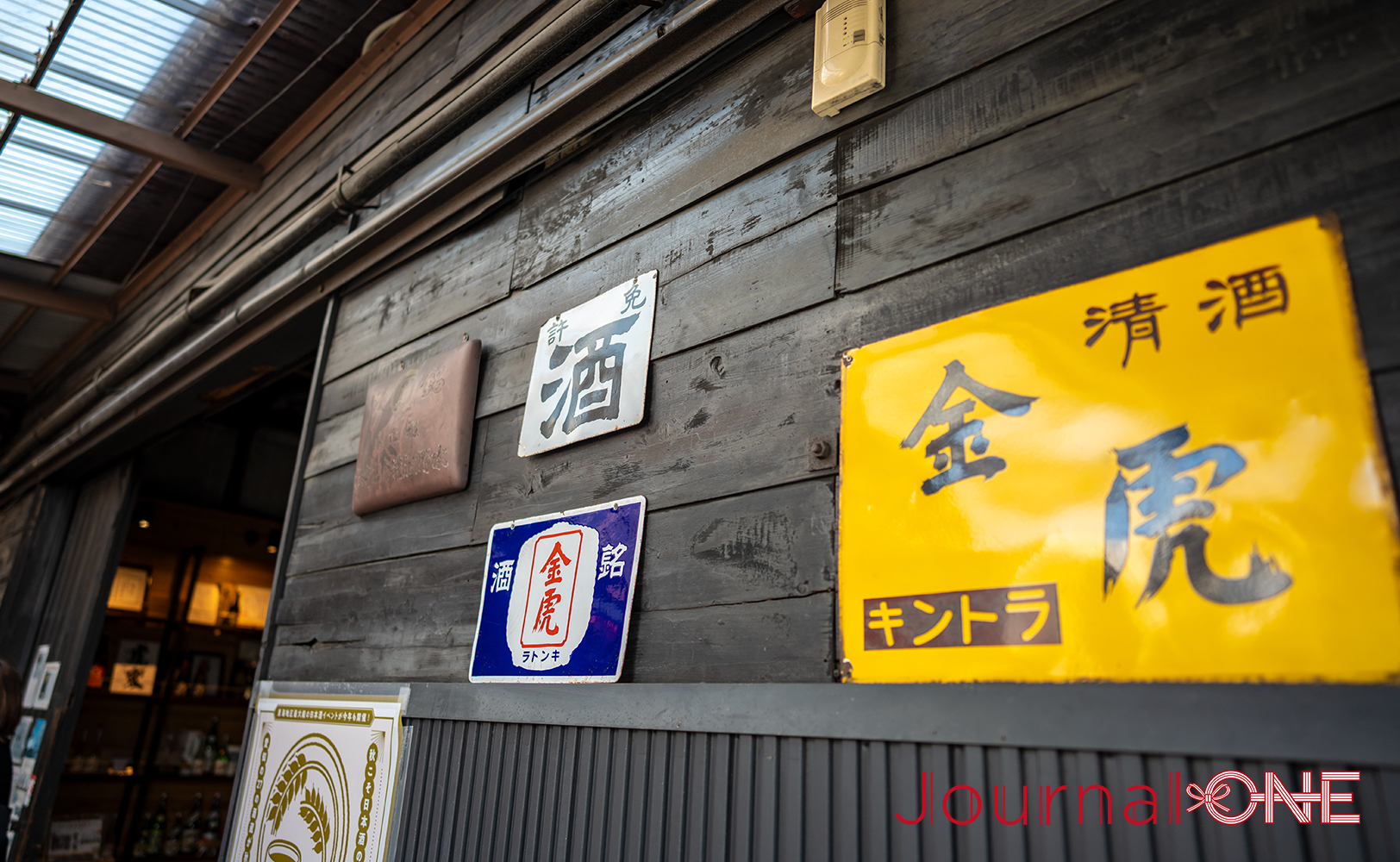
Yamada, in Nagoya’s Kita Ward. In the middle of the town, a short walk from Ozone Station, sits Kintora Sake Brewery. As I stepped inside the brewery, I was struck by a nostalgic aroma that reminded me of home. The brewery was founded in 1845. Its founder began brewing sake in Yamada, a village located at the entrance of the old Zenkoji Kaido (Zenkoji Road). The old map that company president, Zenbei Mizuno, the seventh-generation head of the brewery, unfolded for me showed the Yada River, its crossings, and the road. This brewery was founded beside the river, at the entrance of the road leading to the castle town.
When the brewery was first established, it was surrounded by rice paddies and fields. Eventually, a town rose up around it, and today, it is a brewery in the middle of town, surrounded by houses. The Kintora name, which literally means “golden tiger,” is apparently an homage to the golden shachihoko ornaments of Nagoya Castle and to the fact that the third-generation head was born in the Year of the Tiger. Kintora Sake’s motto is “Brewing Nagoya.” It reflects the unwavering dedication of a brewery that has been making sake for the people of the castle town for generations.
What the water carried, what the wooden vats have inherited
The rivers and plains nurtured their ingredients, and the rivers, ocean, and roads carried their products to Edo and the castle towns. Their founders owned ships, built breweries along canals, anticipated the arrival of ports and railway stations, and established their presence at the entrances to major roads. All of these Aichi breweries were built close by waterways.
This autumn, to coincide with the 20th Asian Games Aichi-Nagoya 2026 and the 5th Asian Para Games Aichi-Nagoya 2026 held in Nagoya and other parts of Aichi, Aichi Fermented Food Culture Promotional Council held Aichi: The Umami Prefecture Fair. For a limited time only (September 8 – October 24, 2026), 21 restaurants and hotels in the prefecture showcased cuisine featuring Aichi’s fermented foods. The sweetness and umami that underpinned Edo’s street foods are still alive and well on the dining tables of this region even today.
However, as I toured these breweries, there was something else that I noticed. Inside those breweries, several things that have been passed down from sake brewing still remain. Next time, we will explore the story of their wooden vats.


