


Aichi’s Fermented Seasonings on Display on Department Store Shelves

The grocery section on the second basement floor. Even early on a weekday afternoon, there is a never-ending stream of customers eyeing the shelves of seasonings (as of the date of reporting).—Photo: Journal-ONE
The day before my brewery tour, as soon as I arrived in Nagoya, I made my way to JR Nagoya Takashimaya department store. I felt sure that, given how deeply embedded fermentation culture is in daily life in Aichi, it would be reflected in the local shops.
The grocery section on the second basement floor, where I was directed, is a place for everyday shopping, with food products gathered from all over Japan on display. The seasonings aisle covered about the same area as Tokyo’s department stores. The difference was in the flow of people. Despite it being early afternoon on a weekday, a steady stream of shoppers pushed their carts through the aisle, stopping in front of the shelves to pick up bottles of soy sauce and vinegar.
That day, all I could manage was to take a few quick photographs, trying not to get in anyone’s way. When I looked back at those photos after my trip, I noticed something. The names of the breweries that I would be visiting from the next day were already on those shelves.
Hichifuku Jozo’s organic white soy sauce. Kokonoe Sakura, a Hon Mirin from Kokonoe Mirin. Mizkan vinegar. All of them shared shelf space with seasonings from various parts of Japan. It was not that the stories of the breweries were being told on those shelves. And yet, perhaps the very fact that these products sit here so naturally on the shelves is proof of how deeply fermented seasonings have become part of the everyday kitchens of this city.

Hichifuku Jozo’s Organic White Soy Sauce. Already seen on the department store shelf even before my visit to the brewery (as of the date of reporting).—Photo: Journal-ONE
On the day of my visit, one floor above, fermentation was on display in a different vein. At a section dedicated to Yamatoya Moriguchizuke Souhonke’s products, there was a display panel explaining the origins of Moriguchi-zuke (pickled Moriguchi radish). Moriguchi-zuke is made by pickling Moriguchi daikon radish, a local heirloom vegetable of the Aichi region, in sake lees and mirin lees. It received wide acclaim at the 1950 Aichi National Sports Festival and subsequently became established as a specialty of Nagoya. The Suzunami display case featured products made by pickling seafood in mirin lees. In this way, the lees left over from sake and mirin production find their way onto the region’s dining tables.

Panel at Yamatoya Moriguchizuke Souhonke section. It describes that Moriguchi-zuke is made by pickling Moriguchi daikon radishes in sake lees and mirin lees (as of the date of reporting).—Photo: Journal-ONE

Mirin Lees-Pickled Seafood featured in the Suzunami display case (as of the date of reporting).—Photo: Journal-ONE
Fermentation that quietly becomes an integral part of everyday kitchens, and fermentation that tells its own story as local specialties. Both, in their own way, are the end points of the journey from the brewery to the dining table.
*Photographs taken at JR Nagoya Takashimaya are all as of the date of reporting. With store renovations that took place on October 21, 2026, the Yamatoya Moriguchizuke Souhonke and Suzunami sections have been relocated to a “Tastes of Japan” section on the second basement floor, and the products handled or displayed, including in the grocery section, have changed (some products can be ordered).
Returning to Hitsumabushi ―― From the Dining Tables of Mikawa
Now, after completing my tour of the breweries, I want to recall once more the meal I enjoyed on the first night of my journey.
At Hitsumabushi Nagoya Bincho in the ESCA underground shopping mall, three small dishes were placed on the table. From left to right, there was mirin used to grill the shiroyaki (plain-grilled unagi eel), white soy sauce (shiro shoyu) to dip it in, and a tamari-based tare sauce. The restaurant’s manager, Fumitaka Matsumoto, explained that all three of these products were made in Aichi Prefecture.

From left to right, mirin, white soy sauce, and a tamari-based tare sauce. All produced in Aichi Prefecture.—Photo: Journal-ONE
Shiroyaki is prepared by first cooking the unagi with the traditional “jiyaki” method of grilling directly over the fire, without steaming, before brushing it with mirin and grilling it again until fragrant and lightly browned. Because the mirin adds sweetness, it is eaten with slightly salty white soy sauce and wasabi, explained Hiroshi Suzuki, President of Bincho Co., Ltd. The suimono, the clear soup served with the main dish, is also seasoned with white soy sauce and salt. The broth in the bowl was crystal clear. White soy sauce adds flavor without adding color. That night, I had tasted the amber-colored liquid from the small dish and felt its intense umami spread across my palate in a single taste. I had assumed that it was tamari. It was only on returning from my journey that I learned that it had, in fact, been white soy sauce.
Suzuki’s explanation of the tare sauce was exceptionally clear. “We simply combine the finest-quality tamari, the finest-quality sugar, and the finest-quality mirin. We do absolutely nothing else.”
That tare sauce’s origins lie in the summers of his childhood. Suzuki grew up in Yoshihama, a suburb of Takahama City. Every year during O-bon, the Buddhist festival in mid-August when families honor and remember their ancestors, his grandmother would buy live unagi eels from a nearby eel farm, grill them outside on a traditional charcoal brazier called a shichirin, and serve them as unadon (grilled unagi over rice). “My roots lie in those memories of making the tare sauce at home with Mikawa tamari soy sauce, what you might call ordinary mirin, and sugar. We would marinate the unagi in that tare sauce and cook it with the jiyaki method.”
Growing up in Mikawa, Suzuki remembers his family eating all their sashimi with tamari. Apparently, their traditional way of eating sashimi was to place slices of tuna on top of freshly cooked rice and enjoy them with tamari mixed with wasabi. Even at catered meals served at hoji, Buddhist memorial services held to commemorate deceased family members on certain anniversaries of their passing, tamari was served instead of ordinary soy sauce. For Suzuki, tamari is not so much “the taste of Nagoya” as the taste of Mikawa’s family dining tables.

Jiyaki unagi, adorned with beautiful charring.—Photo: Journal-ONE
He recalled a time when, visiting his maternal grandparents’ home as a boy, he announced that he wanted to open an unagi restaurant when he grew up, and his grandfather responded with these words. “No matter how deliciously you cook the unagi, it will be no good if the rice doesn’t taste good.” Even today, Bincho restaurants insist on serving their rice freshly cooked and their unagi freshly grilled.
The question I posed in Part 1 of this series was “Where did their sweetness and umami come from?” The mirin that Edo’s unagi restaurants once relied on, the tamari that matured over time in wooden vats. These traditions passed through the kitchens of Mikawa’s homes and live on today in a single bowl of hitsumabushi.

For the third serving, add the condiments and shredded nori, then pour over the dashi broth.—Photo: Journal-ONE
Inherited traditions ―― bamboo taga hoops and human hands
The hoops that hold the wooden vats together are called “taga.” In the past, they were made by weaving strips of bamboo.
Hichifuku Jozo now has only two wooden vats bound by traditional bamboo taga. According to company president Motohiro Inuzuka, the number of craftspeople skilled in making bamboo taga has plummeted, and only a handful remain who are capable of making barrels of this size (20 koku, or approximately 3,600 liters). Yasunori Nakagawa, head of Nakasada Shoten, also recalls being told that there was no longer any bamboo suitable for making taga for larger vats, and that it would be impossible to build any bigger. Even the newest vats have been made by shaving down and reassembling old ones.
At Sato Brewery, they make and fit their own iron hoops instead of the traditional bamboo taga. Because straight lengths of iron must be cut and bent to follow the curve of the vat, it takes a whole day to build a single vat. Unless the hoops are replaced, tamari will leak from the vat. However, apparently, iron can be so rigid that it sometimes damages the vat, and it is in this respect that the advantages of traditional bamboo taga become clear.
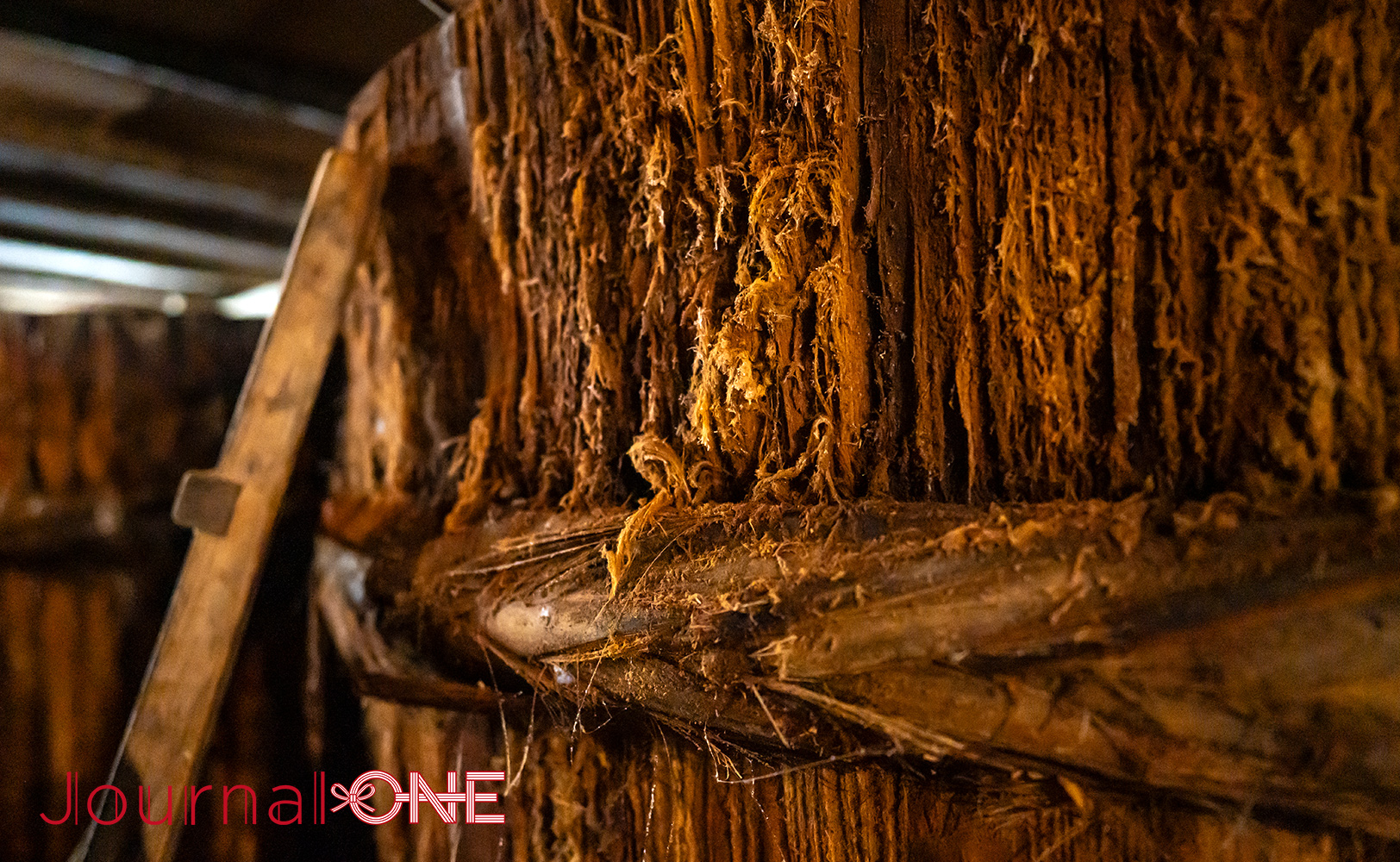
A woven bamboo taga holding together a large wooden vat at Nakasada Shoten.—Photo: Journal-ONE
Three breweries talked about bamboo taga, each in their own way. To preserve the wooden vats is also to preserve the hands and skills of the craftspeople who keep them together.
There are also skills that are passed on from person to person. For generations, Kintora Sake Brewery has drawn on the expertise of Echigo toji, master sake brewers from the Echigo region (present-day Niigata), to produce its sake. At Niigata’s Echigo-style Sake Brewing Techniques Championship, Kintora’s Kohen sake was awarded 3rd place. The heads of the brewery have passed down the name Zenbei Mizuno from generation to generation. At Kokonoe Mirin, the traditional practice of kai-ire, which involves stirring the fermenting mash in a figure-of-eight motion to ensure it matures evenly, continues today, just as it has been in the past.

A Kokonoe Mirin staff member holding up bottles of Kokonoe Sakura and Jun Mikawa Hon Mirin.—Photo: Journal-ONE
Even the lees have been passed down. During the Edo Period, Mizkan sold the lees left over after pressing the fermenting mash as fertilizer. Kokonoe Mirin’s historical records include an entry from 1802 documenting the use of shimo-kasu, the lees left over from shochu distillation, as fertilizer. Mirin lees are still used today as a pickling bed for foods such as Moriguchi-zuke. Hichifuku Jozo takes all of the fermenting mash lees left over after pressing the white soy sauce and the dashi lees left over from producing dashi stock and turns them into resources such as fertilizer and animal feed. The fermenting mash lees alone amount to around 100 metric tons a year. From the Edo Period until the present day, breweries have been making use of lees, without throwing it away.
On the other hand, the traditional rhythms of the breweries are starting to change. This summer, two of Kintora Sake Brewery’s refrigerators broke down. At Nakasada Shoten, as the summers have become hotter, its products are becoming ready earlier than they used to. What can be done to preserve the traditional rhythms of the brewery, which have always been left to natural temperatures, in the years to come? The breweries now face a new question.
What crosses the ocean
Aichi’s fermentation products have been shipped across the ocean for over 100 years. Kokonoe Mirin began exporting its mirin overseas in the Meiji Period. It exhibited its wares at the 1900 Paris Exposition and at an exposition held in Seattle, USA, in 1909. The brewery still has a sign that says “BEST MIRIN” in English.
It is continuing along that same path today. Kenichi Kuno of Sato Brewery has begun shipping mame miso (soybean miso) to Milan in Italy. He said that when he suggested adding a small quantity of mame miso to the tomato sauce for a Margherita pizza, the chefs initially looked puzzled, but after tasting it, they nodded in approval. MISOBEAM, a miso-based sauce that first became popular in North America, has been “reverse-imported” into Japan.
Bincho’s Suzuki recalls the time he brought hitsumabushi to Tokyo. “Basically, we were taking on Edo-style steamed unagi and regular soy sauce head-on.” And now, they are taking steps to take it overseas. Aichi’s seasonings, which were once transported to Edo by sea, are now about to cross the ocean.
What lies beyond the sweetness of that one bowl
Tracing the sweetness and umami of that single bowl of hitsumabushi, I arrived at the transport routes of river and sea, and to the wooden vats inherited from sake-brewing tradition. And now, beyond them, I find the people who have carried this legacy forward and are committed to passing it on to the next generation.
Inside Kokonoe Mirin’s building, a set of guiding principles, or “spirits,” is displayed, commemorating the 250th anniversary of its founding. The last of these reads, “A spirit of bringing the joy of delicious flavors to people around the world for the next 250 years.”
When you visit Nagoya, take the time to trace the origins of that sweetness, on store shelves, at a hitsumabushi restaurant, and at the breweries. I hope that more and more people will come to associate Nagoya with fermented seasonings and make the journey to discover them for themselves.


